

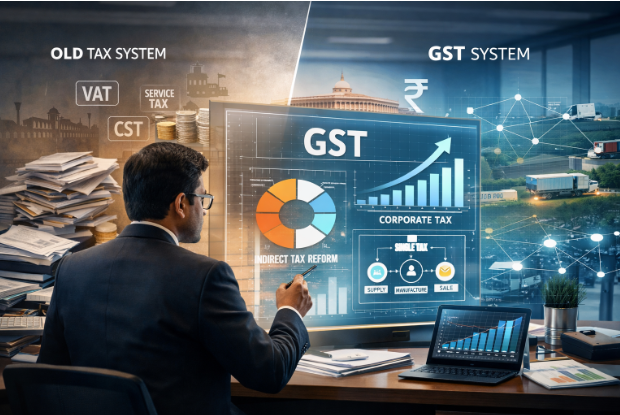
The taxation system in India has seen a major change with the introduction of the Goods and Services Tax. The Goods and Services Tax was introduced in India in 2017, replacing the complex system of indirect taxes. The Goods and Services Tax has introduced a major change in the way businesses approach the tax system.
The Goods and Services Tax has redefined the structure of indirect taxes for corporations. The Goods and Services Tax has also impacted the corporate tax system. The importance of GST Registration must be understood by businesses that want to remain compliant with the current system.
Understanding GST and Its Objectives
GST is a destination-based tax that would be levied on the supply of goods and services. It has been introduced to eradicate the cascading effect of taxes and to develop a seamless national market. It has simplified the tax system by subsuming many taxes such as VAT, service tax, excise duty, and many more into a single tax system.
The major goals of GST are to increase tax compliance, reduce tax evasion, and increase the ease of business. It also ensures the uniformity of tax rates and procedures, which is beneficial for companies that operate their businesses in many states.
GST Registration is a key component of this system, as it brings businesses into the formal tax network and enables them to participate in the GST framework effectively.
Pre-GST Tax Structure in India
Before GST, India’s indirect tax system was fragmented and complex. Businesses were required to comply with multiple taxes imposed by both central and state governments. These included excise duty, service tax, value-added tax (VAT), entry tax, and more.
This multi-layered system led to inefficiencies such as tax-on-tax (cascading effect), lack of transparency, and increased compliance burden. Companies operating across states faced additional challenges due to varying tax rates and regulations.
The absence of a unified system also made it difficult for businesses to optimize their tax strategies. As a result, operational costs were higher, and compliance processes were more time-consuming.
Key Indirect Tax Reforms Introduced by GST
GST introduced several reforms that significantly improved the indirect tax landscape in India. One of the most notable changes was the elimination of multiple taxes and the introduction of a single tax system applicable across the country.
Another major reform was the implementation of input tax credit (ITC), which allows businesses to claim credit for taxes paid on inputs. This reduced the cascading effect of taxes and improved cost efficiency.
GST also introduced a digital compliance system, enabling online filing of returns, registration, and tax payments. This increased transparency and reduced the scope for manual errors and tax evasion.
Additionally, the concept of destination-based taxation ensured that taxes are collected in the state where goods or services are consumed, promoting fairness in revenue distribution.
Impact of GST on Corporate Tax Structure
Shift Towards Transparency and Compliance
GST has significantly improved transparency in the tax system. With mandatory reporting and digital records, businesses are required to maintain accurate data on transactions. This has led to better compliance and reduced instances of tax evasion.
For corporates, GST Registration ensures that all transactions are properly recorded and reported, creating a more accountable tax environment.
Reduction in Cascading Taxes
One of the biggest advantages of GST is the elimination of cascading taxes. Under the previous system, businesses often paid tax on tax, increasing the overall cost of goods and services.
With the introduction of input tax credit, companies can offset taxes paid on inputs against their output tax liability. This has improved profitability and reduced the overall tax burden.
Streamlined Tax Structure Across States
GST has brought uniformity in tax rates and procedures across states. This has simplified operations for companies with a pan-India presence, reducing the complexity of managing multiple tax systems.
Interstate transactions have also become easier, as GST eliminates the need for separate registrations and compliance requirements in different states.
Improved Supply Chain Efficiency
The removal of entry taxes and check posts has improved the movement of goods across states. This has reduced logistics costs and transit times, leading to more efficient supply chain management.
Companies can now optimise their distribution networks without being constrained by tax considerations, resulting in better operational efficiency.
Role of GST Registration in Corporate Compliance
GST Registration plays a critical role in ensuring that businesses operate within the legal tax framework. It allows companies to collect tax from customers, claim input tax credit, and comply with statutory requirements.
For corporates, timely registration is essential to avoid penalties and ensure smooth operations. It also enhances credibility, as many clients and partners prefer working with GST-registered entities.
Furthermore, GST Registration enables businesses to participate in interstate trade and access wider markets, supporting growth and expansion.
Impact on Different Sectors
Manufacturing Sector
GST has reduced the tax burden on manufacturers by allowing input tax credit on raw materials and capital goods. This has improved cost efficiency and encouraged production.
Service Sector
For service providers, GST has standardised tax rates and simplified compliance. However, it has also increased the compliance burden due to regular filing requirements.
E-commerce Sector
GST has brought clarity to the taxation of e-commerce transactions. Mandatory GST Registration for online sellers ensures better tracking and compliance.
Challenges Faced by Corporates Under GST
Despite its benefits, GST has also introduced certain challenges for businesses. One of the main issues is the increased compliance burden, as companies are required to file multiple returns and maintain detailed records.
Frequent changes in GST rules and rates can also create confusion and require businesses to stay updated regularly.
Additionally, technical issues with the GST portal and delays in refunds can impact cash flow and operations.
However, with proper planning and understanding of the GST system, these challenges can be managed effectively.
GST and the Future of Indirect Tax Reforms
GST continues to evolve as the government introduces changes to improve its efficiency and effectiveness. Future reforms may focus on simplifying compliance procedures, reducing tax rates, and enhancing the digital infrastructure.
The integration of advanced technologies such as data analytics and automation is expected to further strengthen the GST system. This will help in better monitoring, improved compliance, and reduced tax evasion.
For businesses, staying updated with these developments is essential to adapt to changes and maintain compliance.
Conclusion
The introduction of GST has transformed India’s indirect tax system, bringing greater transparency, efficiency, and uniformity. It has simplified the tax structure, reduced cascading taxes, and improved compliance across sectors.
Government business loans have become more accessible in the post-GST era, especially for small and medium enterprises. With proper GST registration and consistent GST return file records, businesses can demonstrate financial stability and transparency, which are key factors lenders consider. Schemes like Mudra loans and MSME financing programs are designed to support growing businesses with easier access to credit. As a result, GST compliance not only ensures tax efficiency but also improves a business’s chances of securing timely funding for expansion and operation
For corporations, understanding the impact of GST on tax structures and ensuring proper GST Registration is essential for smooth operations and long-term growth. While challenges remain, the overall benefits of GST make it a significant step towards a more streamlined and business-friendly tax environment in India.
